Posts

Understanding Amazon’s UPC Policy

It was last year, 2016, when Amazon made the decision to batten down the hatches with its UPC [Universal Product Code] and GTIN [Global Trade Item Number] policies. With millions of duplicate UPC listings on Amazon, the company will now revoke — temporarily or even permanently — your account if invalid UPC listings are discovered. Why? The buyers experience becomes marred with an influx of duplicate listings; it’s confusing and waters down product reviews. Here is what the seller now needs to know: GS1 is the only place to purchase legitimate UPCs. Since Amazon’s policy is less than two years old, if you have purchased UPC codes from a third party seller, consult the GS1 database to ensure the information is accurate. Chances are, the codes will identify another company as the brand owner. If this is the case, shut down the listing altogether and replace it with a correct GS1 UPC. Although customer reviews will disappear into the void, your account will not be at risk of suspension...
Master of the Amazon Universe

  In order for a company to keep control over their business and continue to stay profitable, it needs to think strategically about all manner of business. These days selling is so much more than producing a catalogue of products that speaks to customers; it’s also about branding, distribution and managing inventory. For many sellers, utilizing Amazon is a no brainer . Should you elect not to use the Amazon platform, however, it is important to know this: it is likely that a third party seller is already selling your merchandise there, and it is up to you to ensure that a.) this is something you’re comfortable with, and b.) it is represented at a level that meets your standards. While there are measures in place which limits who can sell your products on Amazon, how your merchandise is marketed can affect how the customer perceives your company — off-brand, incorrect information and poor images, for instance, will be off-putting to buyers who will point the blame at you, n...

The All Powerful Sales Tax Nexus

The All Powerful Sales Tax Nexus Customers hail from all over the state and that’s hugely why an online marketplace is so effective. However, online sellers have the at times unenviable task of dealing with the Sales Tax Nexus, a mercurial part of the business where, should a company have some sort of physical connection to a particular state, the seller is then responsible for charging their customers the right amount of sales tax. While all states have variations of the Sales Tax Nexus — and it’s essential that sellers acquaint themselves with the rules, if applicable — it is typically defined as a “physical presence” to a state. This can mean any number of things, such as having an office or warehouse, having an employee, storing inventory, drop shipping from a third party provider, having an affiliate, and even temporarily doing business at a trade show or craft fair. To avoid hassles with the taxing authority, and if your business sounds like it falls under any of the ca...

Amazon ASIN change Notification:What to do

A positive customer experience, in Amazon’s eyes, is paramount. Incidents where products are sold that don’t match the details provided typically ends up with a suspended account if the situation is not swiftly rectified. Should you receive a notification from Amazon stating “Amazon.com ASIN Change Notification” or “Amazon.com ASIN Merge Notification,” this means that a detail has been changed on one of your products, and immediate action might need to be taken on your part. Now, receiving this notice does not necessarily mean there is an issue with the product. Often times, it is alerting you that the wording of the product’s title or description has been adjusted to increase desirability. In these instances, no further action is needed. In any case, be proactive. The email will specify the changes. It is on the seller to visit the listing on Amazon and confirm that no details have been altered (i.e. weight, measurements, etc). If in the event details have been altered incorrectl...
Image
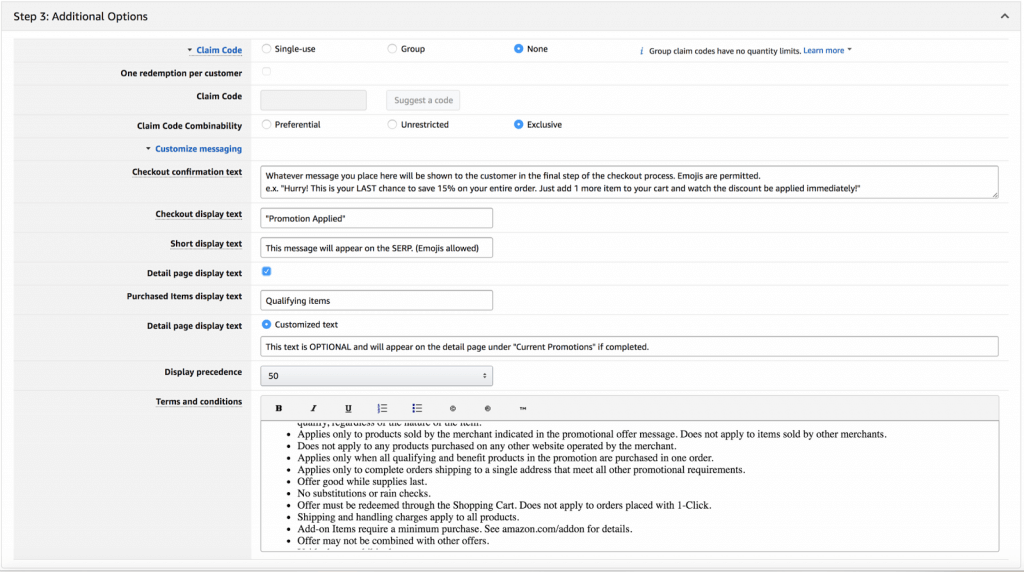
Emojis are taking over — in emails, texts, the movies, and now even in your Amazon product descriptions! It is a gimmick to be sure, but one that is thought to be designed to give your more competitive items (beauty products and vitamin supplements for instance) a slight edge. While strong product copy is always encouraged, adding emojis to the mix has the potential to sway undecided customers in your favor and possibly even increase your click-through rate [CTR]. Directions: Log on to Seller Central. Click “advertising” → “Promotions” then “Create” under “External Benefits.” Select the products that you would like to customize with promotional messaging. Set the schedule for when you want to display the text; it’s suggested to leave this running continuously unless the promotion is time sensitive. Refer to the screenshot below for the correct settings:   The promotional messaging will now be displayed on the SERP, and depending on your settings when creating...

Navigating the Amazon Playing Field

The Amazon landscape is shifting and now, more than ever, sellers are finding themselves in positions where they must solve mercurial issues, and not rely on the backlogged Seller Support team. The fact of the matter is this: sellers must arm themselves with all of the rules and regulations set forth by Amazon if they wish to avoid a headache and financial strain of having their account restricted. Often times, in the case of a dispute or suspension, the best approach with Seller Support is clear and direct communication, an overall understanding of the rules and regulations, and potential solutions that address not only the problem at hand but systemic issues that may arise in the future. For international companies looking to widen their reach and sales on Amazon.com, they must first assess their comfort level in dealing with business practices that may at times feel quite foreign. It is imperative that European sellers research profit margins and price competition while understan...

The Time is now for international sellers

There has never been a better time for the international market to consider branching out to Amazon customers in America. The overall reach is immense, and Amazon needs the merchandise to stay competitive and satisfy its hungry clientele. Non-U.S. based wholesale companies (non-residents and non-corporations) do not need resale certificates. However, international companies must be able to prove their Business to Business status; this can be accomplished by producing documentation from your country. Tax professionals based in the United States can advise as to the pros and cons of registering as a U.S. based business to help you make the best decision for your company. While there are a few steps for non-citizens to take to sell on Amazon.com, it is a pretty clear-cut process. You must sign up for an Amazon account. Provide a credit card (i.e. Visa or Mastercard) that allows international charges. Locate a local bank in your own country that accepts electronic transfers a...